Nyhed
Robotto provides drone software for wildfires, animal counts and defence tasks
Lagt online: 26.05.2026
Nyhed
Robotto provides drone software for wildfires, animal counts and defence tasks
Lagt online: 26.05.2026
Robotto provides drone software for wildfires, animal counts and defence tasks
Nyhed
Lagt online: 26.05.2026
Nyhed
Lagt online: 26.05.2026
Text and Photo: Nelly Sander, AAU Communication and Public Affairs
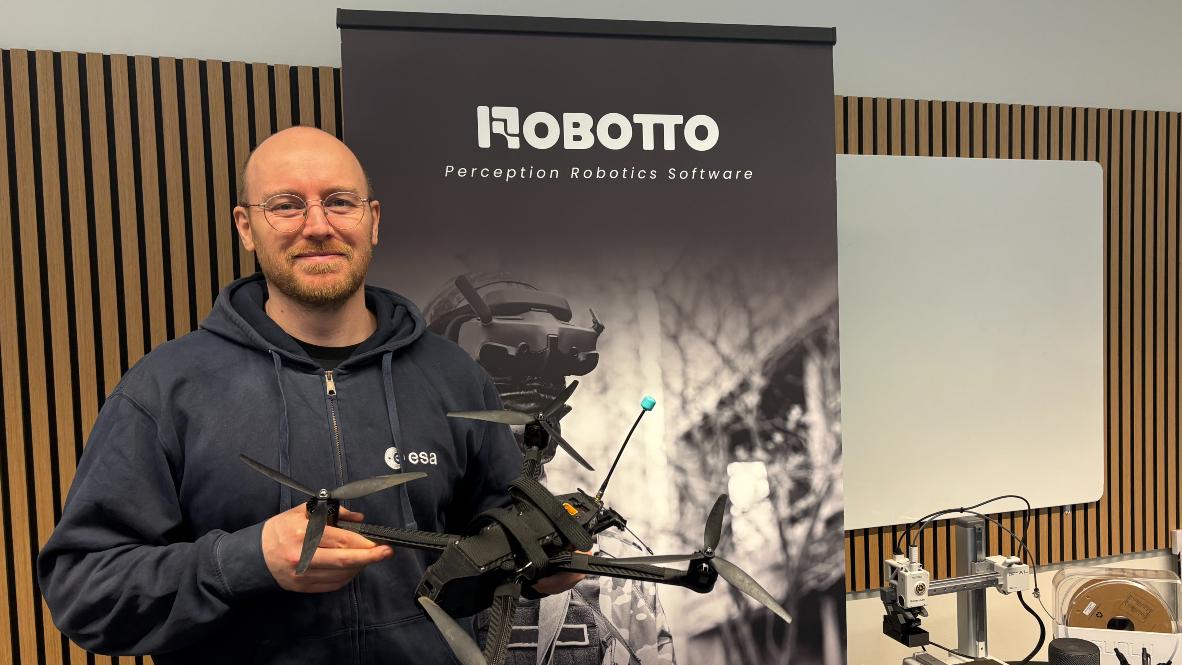
Drones take off and navigate through the terrain. They operate without a constant connection to an operator and complete tasks using artificial intelligence and advanced image recognition. These drones, based on software developed by the company Robotto, are used to map wildfires, count elephants in dense jungles and support operators with precision strikes during the war in Ukraine.
The story of Robotto began in a group room at AAU back in 2018. Kenneth Richard Geipel and four fellow students were working on a bachelor’s project in robotics and wanted to focus on drones and artificial intelligence. Their supervisor encouraged them to be more specific and identify a real-world problem to solve.
“Our first idea was actually pizza delivery using drones, because we were a bit tired of going down to the pizzeria. But Dimitris, our supervisor, said: ‘It’s not serious enough, guys – you need to come up with something better,’” says Kenneth Richard Geipel, CEO and co-founder of Robotto.
The group decided to focus on technology that could assist with the extensive wildfires that raged in the summer of 2018. They developed a method allowing drones to orient themselves using neural networks and a camera, meaning they are not dependent on GPS or a stable connection to an operator. In collaboration with the Danish Emergency Management Agency, they tested the drones in wildfire scenarios.
“We were able to deploy the drone and generate a map in real time. This made it possible for emergency services to respond much more quickly where needed,” says Kenneth Richard Geipel.
The group published two scientific articles about their work, and AAU invited them to several conferences where they presented their findings. This led to several direct invitations to establish a business, and after a period of consideration, four of the group members took the plunge and founded Robotto.
Robotto received support from investors as well as through the university’s start-up programme, where they learned how to turn technology into a business. Soon after, a wide range of assignments began to emerge. Robotto’s technology can be applied in many different contexts, says Kenneth Richard Geipel.
“It’s all based on the same core technology. Whether it's forest fires, animal counts or something entirely different, it’s the same foundation we use,” he says.
In the Thai jungle, Robotto carried out elephant-counting operations. Using drones, they were able to record both the number of animals and their locations. The project was linked to a serious conflict. As parts of the jungle had been cleared for pineapple fields, elephants were left without sufficient food and moved into agricultural areas. This led to deadly conflicts between humans and elephants, and tensions became so high that many locals wanted the elephant population significantly reduced. With data from the drones, park rangers were able to intervene in time and drive the elephants away before conflicts escalated.
Robotto employs 12 people and expects to grow significantly over the coming year. At the same time, the company has evolved in ways they had not initially anticipated.
The majority of Robotto’s business now consists of software sales to the defence industry, for example for use in Ukraine, where operators deploy so-called kamikaze drones against targets such as enemy communicationn systems or supply units.
“We did not expect the defence industry to become such a large part of our business. But this is where development is most rapid at the moment. You could say that the most demanding environments drive innovation – when technology works under extreme conditions, it can also be applied elsewhere,” says Kenneth Richard Geipel.
AAU remains an important partner for Robotto, which recruits from the university and regularly participates in research and development projects.
More about Robotto